
garum
- Civilization
- Roman world
- Period
- c. 5th century BC to late antiquity
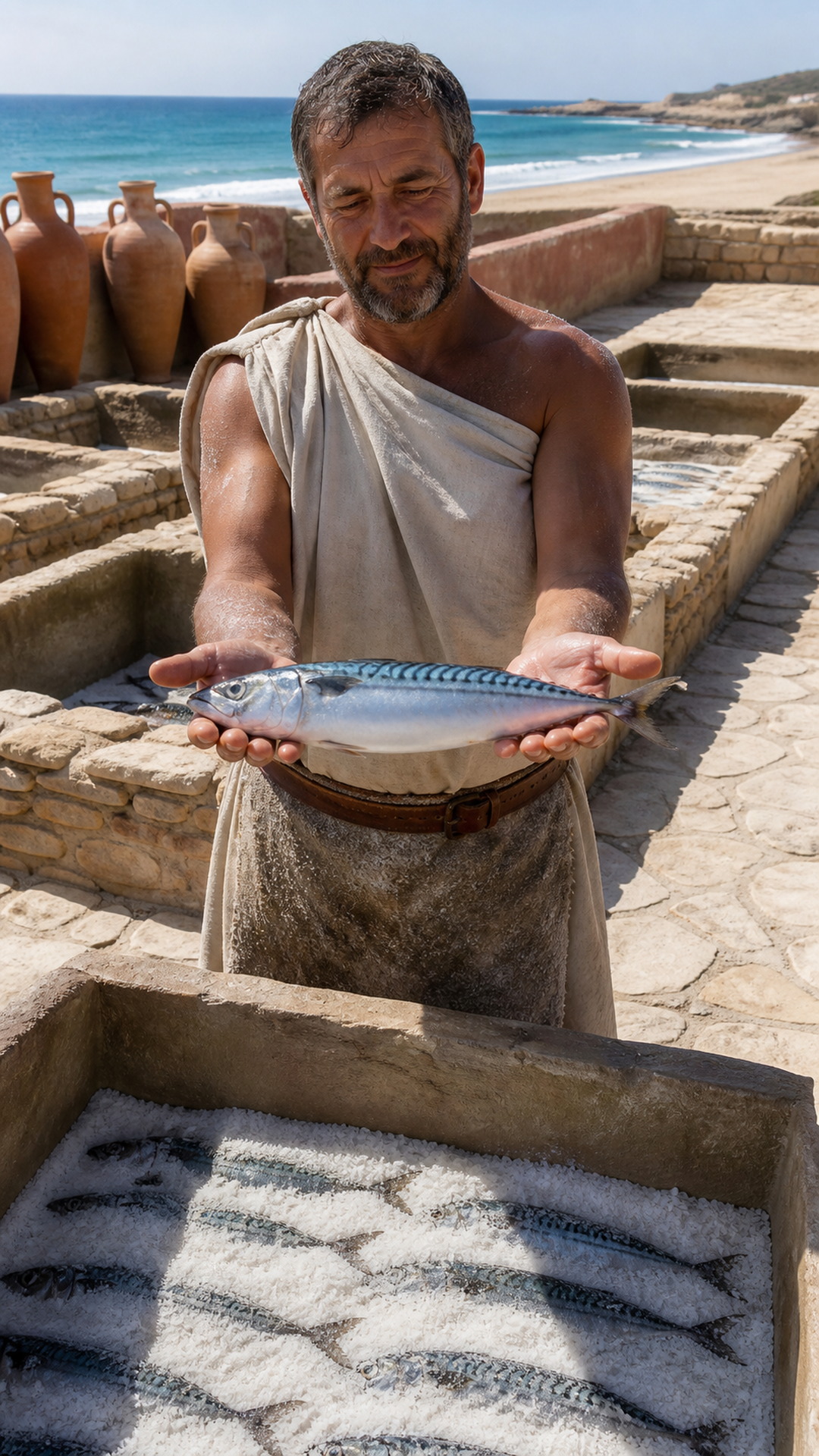
Garum was made by packing fish with a great deal of salt and waiting. The fullest surviving method, in the late compilation known as the Geoponica, gives two measures of salt to sixteen of fish and leaves the mixture two to three months, with stirring, before the liquid is strained off through a close woven basket. The salt is the control: enough of it keeps spoilage bacteria out while the fish's own gut enzymes break the flesh down. The result is not rotten fish. It is a clear, salty, intensely savoury liquid, and the thick residue left behind had its own name, allec.
What the word covered is genuinely unsettled. Ancient texts also use liquamen, muria and allec, and the tidy ladder of four grades that appears in popular accounts is firmer than the evidence: scholars still disagree about whether garum and liquamen named different products, or the same product at different periods. Labels help more than the literature. Painted inscriptions on amphorae name the grade, the fish, sometimes the workshop and the destination, and one attested formula reads G F SCOMBRI, gari flos scombri, the flower of mackerel garum.
It was not a cheap condiment at the top of the range. Pliny reports that roughly two congii, about six and a half litres, of the best sauce made at Cartagena sold for 1,000 sesterces, and that scarcely any liquid apart from perfume was valued more highly. That is roughly ten months to a little over a year of a legionary's gross base pay. Ordinary grades were ordinary prices. The figure belongs to one luxury line from one town.
The reason Roman kitchens could not do without it is chemical. Fish sauce supplies free glutamate, the savoury taste now called umami, and the western Mediterranean had no soy sauce and no other concentrated savoury seasoning. Fish sauce runs through most of the recipes in the collection handed down under the name of Apicius, working as seasoning and salt in one move.
Production was industrial and coastal. At Baelo Claudia on the Atlantic shore of Roman Spain, rows of stone vats sit inside the town walls, some deeper than a man is tall, and Baetican jars travelled to Rome, Britain and the Rhine. The closest living relatives are colatura di alici from Cetara in Italy and the fish sauces of Southeast Asia, nuoc mam and nam pla, which researchers use to reason about how the Roman version behaved.
See the job lived
Sources
- Pliny the Elder, Natural History 31.93-97, trans. Bostock and Riley
- Geoponica 20.46, trans. Thomas Owen, 1805-1806
- Grainger, S. 'Garum and Liquamen, What's in a Name?' Journal of Maritime Archaeology 13 (2018)
- Curtis, R. I. 'Umami and the Foods of Classical Antiquity.' American Journal of Clinical Nutrition 90 (2009)
- Amphorae Ex Hispania (ICAC), Dressel 8 epigraphy