
The Bead-Borers of the Indus Valley
- Civilization
- Indus Valley
- Occupation
- Carnelian bead-borer of Mohenjo-daro
- Material
- Carnelian
- Period
- c. 2500 BC
One long carnelian bead took a full day of drilling, spread over about three working sessions — a bow-drill tipped with ernestite, a stone the Harappans apparently engineered themselves, found nowhere else on Earth. A single 36-bead belt from Allahdino represents more than 480 working days. These beads were the Indus civilization's signature export, traded to Mesopotamia and worn by kings.
Bead making in the Harappan cities
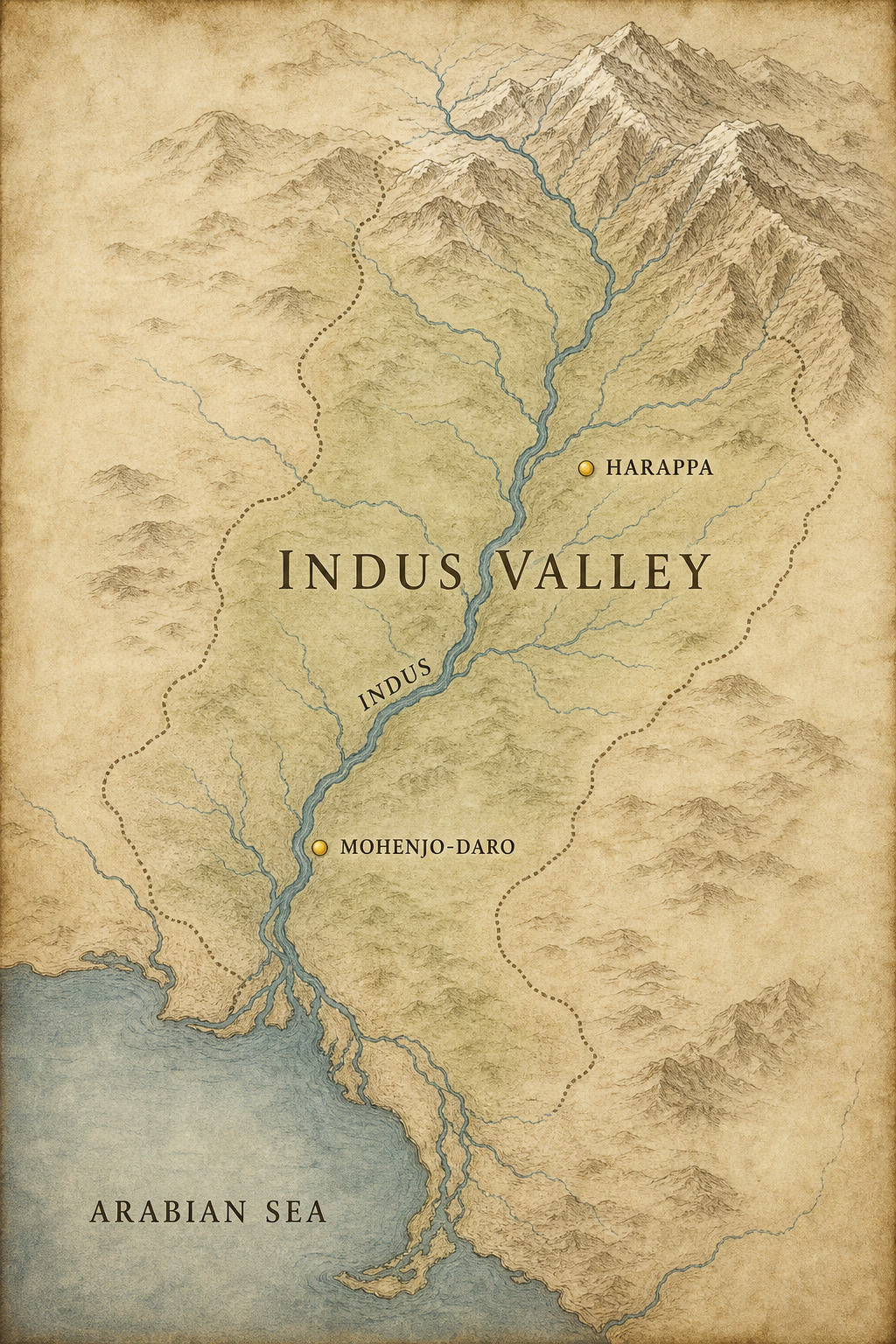
In the Indus cities of Chanhu-daro and Mohenjo-daro, one of the slowest jobs was making a hole. Craftworkers shaped beads from carnelian, a blood-red agate that rates about 7 on the Mohs scale, as hard as quartz. Cutting and grinding a long bead was patient work. Drilling it was harder still.
A single long carnelian bead, roughly six centimetres, took around a full day of drilling. That day was spread across about three eight-hour sessions at the bow-drill, the borer feeding the hole with wet abrasive and turning the tool hour after hour. A belt of thirty-six beads from the nearby site of Allahdino may represent more than 480 working days of drilling alone.
The mystery drill
To pierce a stone as hard as quartz, the borer needed a tip harder than the bead. The Indus answer is a material archaeologists call ernestite, named after the excavator Ernest Mackay. Ernestite drill heads are long and gently waisted, a constricted cylindrical form found at Indus sites and almost nowhere else.
For decades ernestite was read as a rare natural rock. Geochemical work published in 2025 revised that. The stone appears to have been made, not found: powdered sandstone mixed with iron-rich laterite clay and fired to around 1,100 degrees Celsius, yielding a dense ceramic tougher than the carnelian it cut. On that reading, the Indus borer drilled one engineered material with another.
How we know
The timing rests on experiment, not guesswork. Jonathan Mark Kenoyer reproduced Indus drilling by hand and measured the rate, then compared it against agate drillers still working in Khambhat, Gujarat, where the craft survived into modern times. Valentine Roux's long study of those workshops, Cornaline de l'Inde, traced the same sequence of skills back onto the Harappan tools. The worn and broken drill heads left in the workshops carry the record in their wear.
Carnelian beads, from the Indus to Ur
These beads were luxury exports. Indus carnelian, and the drilling method behind it, reached the cities of Mesopotamia, where long and etched carnelian beads appear in elite burials, among them the Royal Cemetery of Ur, more than a thousand kilometres from where the stone was bored. Some beads were made in the Indus; others were cut from Indus stone in local Mesopotamian styles. One bead was days of a specialist's life, and a necklace was a fortune. Carnelian beads from Ur are held in the British Museum, and Harappan bead-making tools survive in museum collections across Pakistan and India.
Sources
- Jonathan Mark Kenoyer — Carnelian Beads, Ancient Indus (Harappa.com)
- J.M. Kenoyer — Stone Beads of the Indus Tradition (2017), book chapter (Harappa.com)
- Origin of the Harappan Ernestites: Geochemical Insights into Provenance and Fabrication (2025), npj Heritage Science
- Nature (news) — Harappans engineered their own super-stone for precision drilling (2025)
- Valentine Roux (ed.) — Cornaline de l'Inde: des pratiques techniques de Cambay aux techno-systèmes de l'Indus (2000), OpenEdition
- Kenoyer et al. — Sourcing carnelian beads from the ancient Mesopotamian site of Kish, Iraq, 2450–2200 BCE (2025), Archaeometry
Tell us in the comments — the next episode is picked from what you ask for.
Subscribe on YouTube Watch the seriesMore from the series

The Woman Who Spoke for Apollo

The Dancers Who Were Offerings