The Masons Who Freed a Building from a Cliff
- Civilization
- Nabataea
- Occupation
- Rock-cut facade carver
- Material
- Rose sandstone
- Period
- c. 50 AD
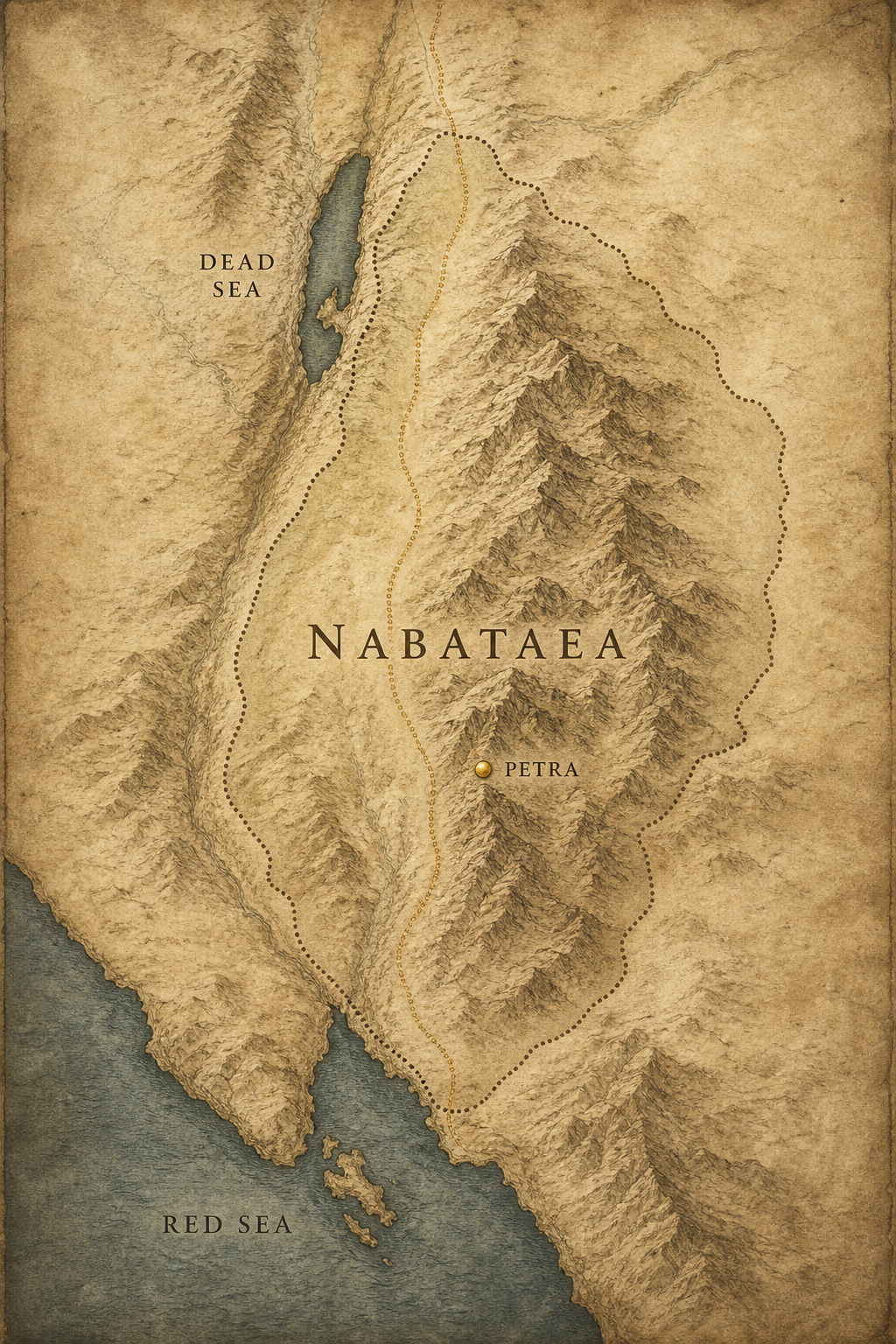
The Nabataeans carved the Treasury of Petra straight down out of one rose-red cliff — top to bottom, standing on ledges cut from the rock itself. They didn't stack stone; they freed the building from it. They call it Al-Khazneh, the Treasury, but it hides no gold. The wonder is the cliff, still standing two thousand years later.
The job
The carver's workshop was a cliff. At Petra, in what is now southern Jordan, Nabataean masons cut tombs and temples straight into the rose-red sandstone, and the grandest of them is Al-Khazneh, the Treasury. It stands about 39 meters high and 25 meters wide, every column and pediment shaped from a single rock face rather than built up from blocks.
There was no assembling here, and no correcting. A chisel stroke in the wrong place could not be undone. The worker who cut the Treasury's Corinthian capitals and the winged figures across its front was carving a facade that had to be right the first time.
Top-down
The Nabataeans worked from the top down. Masons began at the crown of the cliff and cut a narrow ledge across its full width, then carved the architecture level by level as they descended. Each stage had to be finished before they dropped to the next, because once the working surface below was quarried away there was no climbing back up to reach it.
This solved a hard problem. Wood was scarce in the desert, so instead of raising ground-up scaffolding the masons left a thin wall of stone in front of the emerging facade to stand on, cutting it away as the work moved down. The scaffold, in effect, was the cliff itself.
How we know
The clearest evidence is the unfinished work. Around Petra, tombs abandoned partway through show finished detail at the top and rough, blocked-out stone below, the exact pattern a top-down sequence would leave. The architect Shaher Rababeh studied these traces for his book How Petra was Built, reading the pick marks, quarry faces, and trench-and-wedge cuttings the masons left behind, and argued that wooden scaffolding was neither practical nor necessary.
In 2024 a separate find reinforced the building's purpose. Archaeologists located a sealed chamber beneath the Treasury holding twelve skeletons and grave goods of bronze, iron, and ceramic, confirming that the monument was a tomb.
Where to see it
Al-Khazneh still stands at the end of the Siq, the narrow gorge that opens onto its facade. It is roughly two thousand years old, carved during the reign of the Nabataean king Aretas IV in the early first century AD.
The name is a mistake. Local Bedouin called it the Treasury because they believed a pharaoh had hidden gold in the stone urn near its top, and bullet marks still scar the urn from attempts to break it open. The urn is solid sandstone. There was never any treasure inside.
Sources
- Shaher M. Rababeh — How Petra was Built: An Analysis of the Construction Techniques of the Nabataean Buildings and Rock-cut Monuments (2005), BAR International Series 1460, BAR Publishing
- Bryn Mawr Classical Review — review of Rababeh, How Petra was Built (2007)
- Visit Petra (official, Petra Development and Tourism Region Authority) — Al Khazna (The Treasury)
- Phys.org / American Center of Research — Researchers discover hidden tomb beneath Petra's Treasury World Heritage Site (2024)
- NPR — Archaeologists discover 12 skeletons at a buried tomb in Petra, Jordan (2024)
- Al-Khazneh — Wikipedia (supplementary)
Tell us in the comments — the next episode is picked from what you ask for.
Subscribe on YouTube Watch the seriesMore from the series
The Dancers Who Were Offerings
The Dyers Behind the Colour of Emperors