
The Dyers Behind the Colour of Emperors
- Civilization
- Carthage
- Occupation
- Murex purple-dyer
- Material
- Tyrian purple
- Period
- c. 300 BC
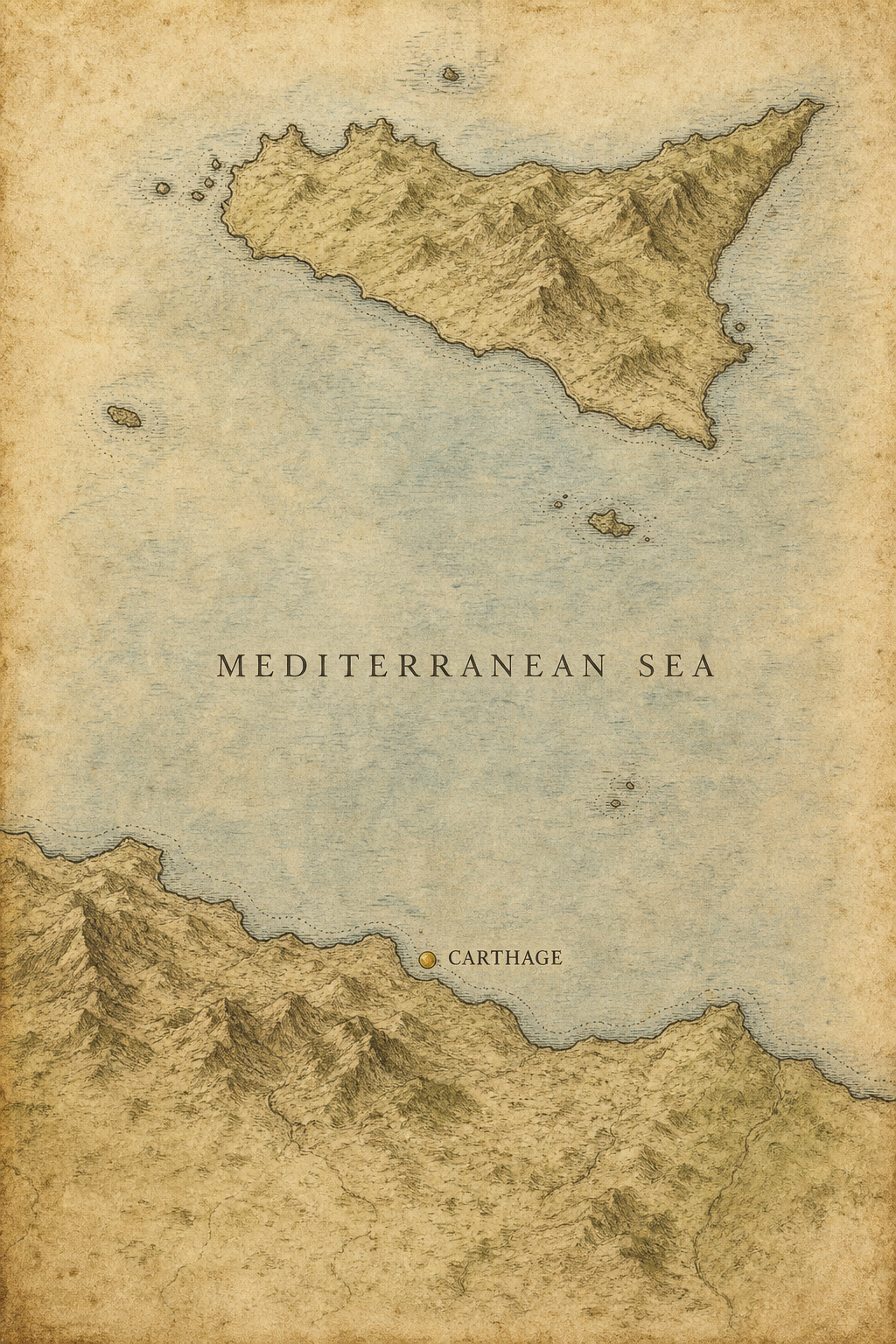
Tyrian purple — the color of kings and emperors — hides in the murex sea-snail: twelve thousand of them for barely a gram and a half of dye. The dyeworks stank so badly they stood apart from the living city. Rome wiped Carthage off the map, but never the purple.
The job
The purple-dyer worked at the stinking edge of the Punic world. Carthage and its sister towns along the Tunisian coast built one of antiquity's most valuable industries around a sea snail. The dyer's raw material was the murex, a predatory mollusc gathered by the thousand. From a gland in each animal came a few drops of clear fluid that turned, in air and sunlight, into a purple so deep and so fast it never truly faded.
The work was foul. The glands rotted as they were processed, and the reek of decay and brine clung to the vats. For that reason dye works stood apart from where people lived. At Phoenician Sidon the workshop lay some fourteen kilometres from the city; the dyers of Carthage and Djerba worked at a similar remove.
Tyrian purple: the colour of kings
Tyrian purple was the most costly dye in the ancient world, and law and custom reserved the deepest shades for kings, Roman emperors and the highest elite. The expense lay in the arithmetic. In 1909 the chemist Paul Friedländer processed the glands of about twelve thousand murex to obtain just 1.4 grams of pure pigment, enough, one historian reckons, to dye little more than the border of a garment.
The active compound is 6,6'-dibromoindigo, a relative of common indigo carrying two atoms of bromine. That small difference is part of why the colour grips the fibre and holds against light and washing.
How we know
Ancient writers describe the glands salted, steeped, then simmered for days in metal vats until the liquor came right. Little of the Punic method survives in words, because Rome razed Carthage in 146 BC. What survives is the waste.
Archaeologists read purple production from three things: heaps of crushed murex shells, the tools and tanks that broke and cooked them, and traces of the pigment itself. At Meninx on the island of Djerba, a production centre from Punic times into late antiquity, mounds of smashed banded murex still mark the shore. Comparable shell middens ring the coast at Kerkouane and other old Punic sites.
After Carthage
The city fell, but the colour did not. Purple-making carried on along the same coast under Roman rule, and Meninx was still shipping dye centuries later. Pliny ranked its purple second only to that of Tyre. The trade outlived the empire that had destroyed Carthage and reached deep into Byzantine times, when imperial children were still, in the old phrase, born to the purple.
Sources
- Cooksey, C. J. — Tyrian Purple: 6,6'-Dibromoindigo and Related Compounds (2001), Molecules 6(9): 736–769
- Ritter, S. & Ben Tahar, S. (eds.) — Studies on the Urban History of Meninx (Djerba): The Meninx Archaeological Project 2015–2019 (2022), Deutsches Archäologisches Institut
- Berger et al. — More than just a color: archaeological, analytical, and procedural aspects of Late Bronze Age purple-dye production at Cape Kolonna, Aegina (2024), PLoS ONE 19(6)
- Cartwright, M. — Tyrian Purple (2016), World History Encyclopedia
Tell us in the comments — the next episode is picked from what you ask for.
Subscribe on YouTube Watch the seriesMore from the series
The Masons Who Freed a Building from a Cliff
The Jewelers Who Worked in Living Teeth