The Jewelers Who Worked in Living Teeth
- Civilization
- Maya
- Occupation
- Dental inlay artisan
- Material
- Jade
- Period
- c. 700 AD
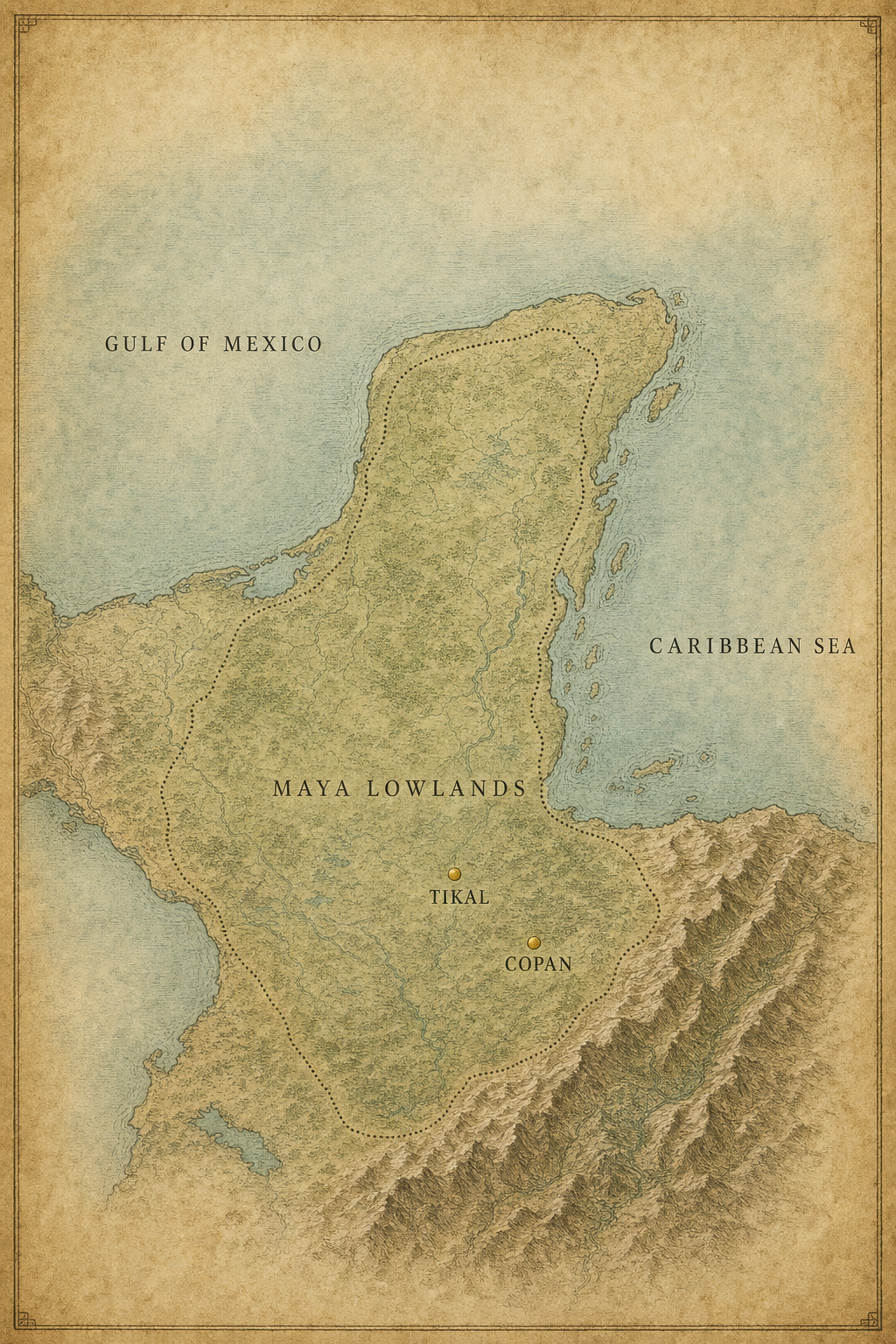
A real job in the ancient Maya world: drilling holes in living front teeth and setting them with polished beads of green jade. The drill marks, under an electron microscope, show the control of a trained jeweler — and the jade still glitters in 1,300-year-old skulls across Mesoamerica.
The job
In the Maya lowlands, some of the most demanding craftwork was done inside a living mouth. During the Classic period, roughly 250 to 900 CE, a specialist drilled the front teeth of clients and set them with small polished stones. The work was cosmetic and social: a jade or pyrite inlay in a front tooth marked status, beauty, and identity, and it stayed with a person for the rest of their life. The craft overlapped with jade-working, and the same patient drilling and abrasion that shaped jade ornaments was applied to the teeth themselves. The patients were alive and their teeth were healthy when the work was done.
Mayan dentistry: how the jade tooth gems were set
The artisan worked mainly on the incisors and canines of young adults. A rounded cavity was cut into the enamel and dentine with a small rotating drill; under an electron microscope, the marks show the control of a trained jeweler. The cut stopped short of the pulp, the soft core of nerves and vessels, so the tooth stayed alive. A shaped stone — most often jade, sometimes pyrite polished to a mirror shine — was fitted into the hole and fixed with a plant-based cement. The bond held. Many inlays are still seated in the teeth that archaeologists recover today.
How we know
Thousands of modified teeth have been recorded from more than a hundred Maya sites, most comprehensively in Vera Tiesler's survey of the practice across three millennia. A radiological study of 193 inlaid teeth found signs of continued pulp vitality, evidence that the drilling was careful and the teeth generally survived it. In 2022, a chemical analysis of sealants from sites in Guatemala, Belize, and Honduras identified about 150 organic compounds in the cement. Several of them — pine tar, sclareolide, and oils from plants in the mint family — carry antibacterial, antifungal, or anti-inflammatory properties. The cement seems to have protected the drilled tooth as well as held the stone in place.
What survives
Inlaid teeth and jaws are held in Mesoamerican collections, among them the Popol Vuh Museum in Guatemala City, where one gem-set molar was recently identified. The jade keeps its polish. In skulls more than a thousand years old, the green and gold inlays still catch the light, set exactly where a Maya specialist placed them.
Sources
- Hernández-Bolio et al. — Organic compositional analysis of ancient Maya tooth sealants and fillings (2022), Journal of Archaeological Science: Reports 43
- Tiesler, V. — Ancient Maya Teeth: Dental Modification, Cosmology, and Social Identity in Mesoamerica (2024), University of Texas Press
- Prehispanic Maya dental inlays in teeth with open apices: implications for age of cultural practices (2025), Journal of Archaeological Science: Reports
- National Geographic — The ancient Maya may have had sophisticated dentists
- Science (AAAS) — Ancient Maya tooth sealant glued gemstones in place — and may have prevented tooth decay (2022)
Tell us in the comments — the next episode is picked from what you ask for.
Subscribe on YouTube Watch the seriesMore from the series
The Dyers Behind the Colour of Emperors

The Diviner Who Read Tomorrow in a Sheep's Liver